
Art of the Caves: Story Part 1 – Grades K-3
 Click here to play or pause the audio.
 Use this scrollbar to read along,viewing the entire story and visuals.
Docent Instructions: The word Pause is the suggested point in which to pause the story and to ask your students to share ideas with the students next to them about what they learned in the previous part of the story for approximately 1 to 3 minutes. This allows for cooperative learning to occur.
Art of the Caves: Story Part 1 – Grades K-3
Copyright Denise T. Federico 1/11/04
“Hey guys and girls, come here! I’m looking at this map Mr. Perez the art wizard gave us.
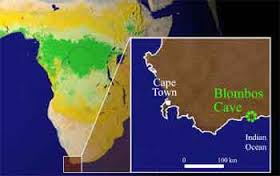
Map of Blombos Cave South Africa
That hole in the ground we have to find for our project should be right around here somewhere.
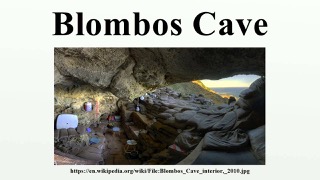
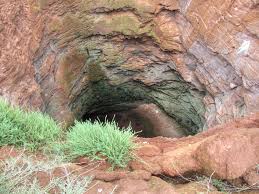
Cave Entrance Hole in the Ground
Look, there it is. It’s an opening. Wonder what’s inside. Looks big enough to crawl into. I’ll bet this is a cave in the ground. I know caves can be as big as a whole room even many rooms with passageways. My mom says don’t go into holes. But I see a note over there. It says: Welcome to kid’s day. This is a cave and you’re all invited to a magical look inside, be brave and enjoy!
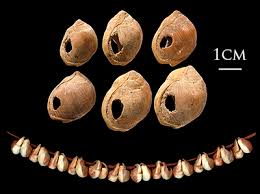
Sea Shell Beads strung into Necklaces
First, pick up one of the necklaces made with shells near your feet and put it on. They look very old and they will take you way back to the time they were made—many, many thousands of years ago, by early humans. Wow! That’s the end of the note! Well, I’m brave enough to be the first leader to see those early humans. Let’s go. Follow me.”
(Pause here.)
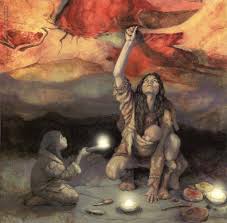 “Okay, don’t be afraid, it’s not Halloween today so we won’t see any scary skeletons. Don’t you wonder what could be inside? Oh, here’s another note. It says: Use these torches. They are like the ones the early people made from plants with animal fat to light their way. The caves can even be up to four miles deep into the earth and dark.” All right, gang. Take one each. Onward! Now wait, we’ve gone a little ways and I do see something ahead. It’s people making something. And now I hear an “ouch” coming from that rock I just stepped on.”
“Yes, you heard right! Come closer kids to my rock mouth. I’ve been in this cave in Africa from long ago times—for many thousands of years, and I also come from your time in the future. It’s a little magical, I know.”
“Well okay, then, Mr. Rock. We all like magic, don’t we guys? And I heard of Africa. I have some friends whose family came from Africa. Okay, continue on, Mr. Rock.”
“Thank you. You all should be proud of being good listeners! These long ago times were called prehistoric. The people you are seeing are from those long ago times. They do not know our English way of talking. But they had special ways to share their thinking and feeling. They created art, which was a great thing. That was one way they shared with each other. It’s also what makes people different from animals—animals do not make art. These early people are called modern man or Homo-Sapiens, which means ‘Smart Humans.’ They do look different from people today, but their brains and bodies were very much like yours. Now head over to that cave on your left. But first what do you notice about the rock right next to your toes? ”
“Look, everyone, this rock has crisscrossing lines carved into it, and it’s kind of red. It looks more like art than just a rock to me! What do you think Mr. Rock?”
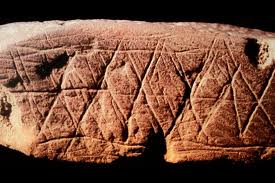
Red Ocher Sculpture
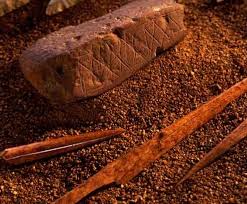
Red Ocher Sculpture and Bone Awls
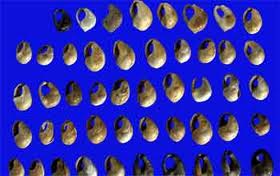
Sea Shell Beads
“Bingo, right you are! This is one of the oldest pieces of art with diagonal or crisscrossing lines. It’s made from a soft rock, a mineral, called red ocher. The Homo-Sapiens made that pattern, and also made your sea shell necklaces by cutting holes in the shells with that sharp tool—lying over there—that bone awl.
Early modern man had to think of how to make a tool to use, and this was a first tool! And because early man made the tool and carved the rock and made holes in shells and strung them for necklaces and bracelets—all those things show proof that early man thought about art and made art. You all have the special gift of being able to create art. You know, art is not what nature made, but what people make. What kinds of art do you like to make?”
(Pause here.)
“Did somebody say doing handprints on your wall and finger painting? Well let’s take a look inside another cave. We’re going to leave this cave called the Blombos Cave here in South Africa, where this carved rock was first discovered.
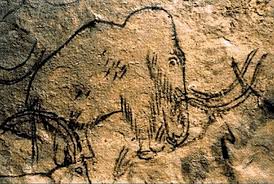
Woolly Mammoth
Now we are entering into a cave on the continent of Europe. Before you peek in, what do you imagine you’ll see in this cave? Okay, take a look in. Would you like walls like this for your room? Did someone say that’s a strange looking elephant that you don’t see in a zoo? You’re so smart. That’s the woolly mammoth and other animals these early people hunted. See if you can pick them out. There are hyenas, auroch, rhinos, woolly mammoth, deer, lions, mountain goat, ibex, horses and bulls, and cave bear. Give a shake to your magic shell necklaces. That will give you a magic moving picture. Can you see the animals in those very early times, roaming around the damp cold ground called tundra and eating the grass?”
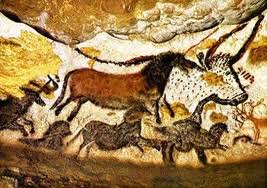
Lascaux Cave Animal Mural
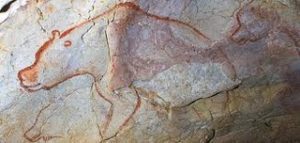
Cave Bear
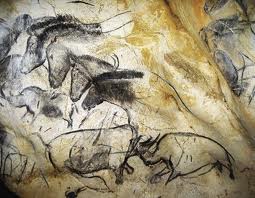
Chauvet Cave Animals
(Pause here.)
“Oops, my time is almost fizzling out. Follow that path to another cave and you’ll see who does the paintings on the walls. Did I hear somebody say they see some more bone awls and other tools?”
“Yes, Mr. Rock, and we all see some people using the tools to dig in the frozen ground. Hey, they’re burying food!”
The early people’s tools helped them to hunt animals and fish for food. Then they buried some food. Even the plants, herbs and fruits that they picked they saved in the ground just like your refrigerators save your food.”
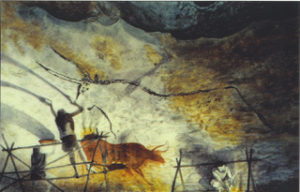
Shaman Painting on the Cave Walls
“Now inside the cave there is somebody painting called a Shaman. A Shaman is a medicine man or woman who had a special talent for painting. These early peoples believed their art could cause hunting magic. It would help them with their hunt and make sure there would be many animals around for future hunts.”
Feel the magic surrounding the Shaman and quietly, slowly, turn around to leave the cave. We do not want to disturb the wise Shaman’s work. Come back out of the cave into the bright sunlight, stretch, and get ready to become ‘Prehistoric Artists’ yourselves!”